Wolves Eat Sheep
In my differential equations class I took last year, I remember briefly covering population growth and modeling both exponential growth and logistic growth by solving ordinary differential equations.

But of course, most populations have predators and prey rather than just a single species. On our final, which the teacher admitted was insultingly easy, we were presented with the following (I highly recommend you try solving it on your own before you continue reading):

When I saw this question, my line of reasoning went as follows:

Those equations are the Lotka-Volterra Equations for predator-prey interactions (not to be confused with the Lotka-Volterra Equations for modeling interspecific competition). Of course it’s not perfect—it’s incredibly simplified and assumes the prey population grows exponentially. But it’s pretty good at showing the effect each population has on both populations, and it demonstrates the cyclic fluctuations that each population experiences.
Predation
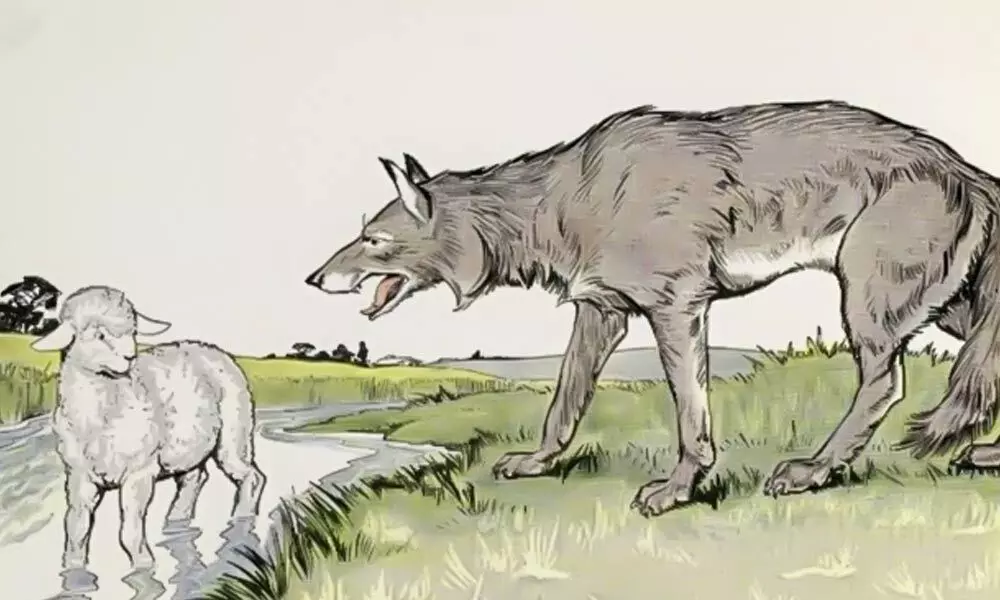
Isn’t it funny how predators depend on prey for survival, yet they actively decrease the amount of prey available? Isn’t it amazing that prey benefit from predators on a macro level, despite being harmed on a micro level?
I think it’s quite interesting. If there were too many predators, then the prey would die out. However, if there were too few predators, they have a higher chance of becoming (locally) extinct, allowing prey to roam freely. Both situations are less than ideal, and in this sense, predator-prey populations require a delicate balance to flourish. A classic example of such an interdependence is the removal and reintroduction of grey wolves to Yellowstone National Park. When grey wolves were extirpated (hunted until extinction) in 1926, the elk population skyrocketed, which resulted in overgrazing and an overall degradation of the environment. However, when they were reintroduced in 1995, a trophic cascade occurred—beaver colonies increased in number, willows, cottonwoods and aspens flourished, and biodiversity increased. Although Yellowstone’s ecosystem hasn’t fully recovered to its previous state before 1926, it has seen significant improvements since the reintroduction of the grey wolves.
I think I’ve been told to think that predators are bad for prey. Yes, getting eaten isn’t the most pleasurable experience, but if we look beyond these micro-interactions, we see that the predator-prey dynamic is much more complex than predators eating prey. One phenomenon that occurs is coevolution, where the two species enter an “evolution arms race”, with each species affecting the other species’s evolution through natural selection. Over time, predators become more effective in catching prey, and prey become more effective in evading predators, with the weaker predators and prey less likely to reproduce. In a sense, both populations become more fit due to the pressures imposed by the other population.
That’s all. Just something I found interesting that I wanted to talk about.
Life Update!
I’ve been going to the gym! My arms are so sore as a result, but it’s fine. My sleep schedule has been suffering so much though. It’s extremely unhealthy, and I always feel tired as a result.
Another thing—I finished my college applications a while ago, and now I have scholarship applications to fill out! It’s just more applications, more filling out honors, activities, volunteer work and jobs, and more essays to write. The applications just seem endless.
So in conclusion, nothing much is going on in my life right now. However, I have plenty of things to look forward to, and the senioritis hasn’t kicked in yet! So maybe we’re doing fine.
Comments
Post a Comment